
“There’s definitely a backlash against noise”

Being the longtime lead author of the Reuters Institute’s Digital News Report, Nic Newman has collected data on news consumption for more than a decade. By analyzing data and leading focus groups, he and his co-researchers have observed significant changes in behavior by young audiences: These days they overwhelmingly access news via social media and expect the consumption experience to be frictionless. I interviewed Nic for a research project on Gen Z and News by Mediengruppe Wiener Zeitung.  

Nic, you have studied news consumption behaviour of different age groups for decades. What do media organizations need to know if they want to reach young people today? 

Nic Newman: People who grew up with social media show very different behaviours from those of previous generations. They want everything friction-free – ­and immediately –  and they want to consume content where they are. They don’t want to go to news websites or apps. And they want their consumption to be easy, entertaining, fun. That’s a big challenge because do you change your journalism to make it more entertaining and fun? Or do you just accept that they’re going to come less often to you because you’re not very entertaining and you’re not a lot of fun?

Is there such a thing as “the young audience” some in the media are talking about, or does your research reveal different young audiences? 

One of the defining features of this younger audience is just how varied their consumption is. We’ve done qualitative work where we’ve talked to individuals in different countries, and everyone has got different media habits. For example, it’s not true that all young people use TikTok for news. There are many who hate TikTok. We found people who had very clear routines, almost like those of newspaper readers. We saw them reading The Economist at exactly the same time every morning on their commute as they briefed themselves on the things they needed to know for work. You have the typical lifestyle effects when as you get older and go into a job, there’s information you need. Just young people’s way of accessing that information is going to be different, the unhappiness with any kind of friction applies to all. 

Presumably education and social status matter, too.

Education is always the biggest divider in terms of how interested people are in news. The more interested people are in news, the more likely they are to build a relationship with a brand or with an individual. That’s the other big trend: that many young people prefer to access news through an individual they trust. 

You did a major report on creators for the Reuters Institute. What were your key findings?

It varies by country. We all know the politically polarizing creators in the US, the Joe Rogan types. There are a lot less of these in Europe. There you see more of those educator types like MrWissen2go in Germany. In explanatory journalism creators are clearly filling a gap that traditional media does not fill. The third area is the specialists who are building really deep, authentic relationships in a particular subject area. This also threatens traditional media companies, because these individuals have an incredibly low cost base. Many of them came from mainstream media but now think it’s better to operate on their own. 

Some data shows we have reached peak social media – now that even the most backwards media brands have realized they need to give it a go. 

There’s definitely a backlash against noise. But it might be impossible to even talk about social media anymore. Social media used to be social: about what your friends were doing. But that has been declining. In the past two to three years, it has developed from content that came from someone you knew to content that is essentially driven popularity using AI driven algorithms. A lot of that is fuelled by video. People aren’t getting bored with YouTube or TikTok, that’s growing. 

What does that mean for the media industry? 

One of the implications is the competition for attention within the new discovery mechanisms. The platforms are setting themselves up as creator friendly, they want to attract the best content that’s going to keep people’s attention. And again, they find that although professional media is part of that, people are paying more attention to non-professional media, to authentic personalities. Younger people are paying a lot of attention to people who look like them. Traditional media are struggling to behave like creators, because their sometimes less objective approach doesn’t fit with journalistic norms. The other growth area is through AI. Young people are more likely to access news and information through AI, because it’s friction free, quick, easy, and gives them what they want, it is personalized. 

What would you recommend editors and media organizations to do in this situation where both is quite foreign to them: creators and AI-based discovery?

Most media companies are thinking about investing more in video, particularly in vertical video that builds an authentic trust relationship. You’ve seen the New York Times and a range of other media companies putting vertical video on their front pages, trying to bolster the visibility of their own personalities and journalists to the extent that these are looking directly at you in the camera, building that sort of authentic direct relationship. They’re trying to copy a few creator techniques. Other strategies are to partner with creators or to co-opt them and bring them on staff. A whole list of companies have done that, in the UK for example the Daily Mailand the Independent. The third possibility is to engage with existing creators in particular fields, for example in investigations to help with distribution or content creation

What are the most common mistakes that you observe in newsrooms – apart from not doing anything for young audiences?

Probably the biggest mistake is an old newsroom trying to be down with the kids. Some older television anchors have done very well on TikTok, but in general, young people do not want you to dumb down. They want you to maintain your credibility and institutional authority. Don’t not cover politics or other important subjects because young people are spending less time on these issues. Try and make it accessible. Think hard about the formats you’re using. This works for older people as well. The other common mistake is to do a brand for young people, unless you do it to learn something from it. There have been very few cases where that has been successful. 

Why is that? Some young editors in large media companies have put quite some effort into developing those brands. 

Because in most of those cases you’re trying to get young people to do something they don’t want to do, which is come directly to an app or to a website. And if it’s a brand that only works in social media, you might as well build a personal brand or try and amplify the message of the existing brand rather than trying to create a new one. It is different if you are a digital first brand like Zetland in Denmark where you have a very clear audience in mind to begin with. 

What is their secret sauce?

One important aspect of this is representation. Young people struggle with traditional brands because they don’t feel that the journalists and the newsrooms really understand what they’re interested in – both in terms of the agenda and in the way they like to consume media. For newsrooms that are primarily employing people age 45 and older, it’s very hard to speak authentically to a younger audience. Zetland’s founders were of that generation.

One of their recipes for success seems to have been their audio first concept. Because the data shows that young people like long stories – when they can listen to them. 

That’s another myth about young people: that they’re not interested in linear, they’re not interested in long form. Obviously, they binge on long television series, they binge on podcasts. But the kinds of podcasts they’re listening to are an accessible, easy mix of entertainment and information. There’s a lot of humour involved. And again, that works well with older people, too. Interestingly, podcast is becoming video. What we found in our research for the latest Digital News Report is that younger people watch podcast videos because they want to get closer to the host. Whereas older people say, it’s all about audio. And then you’ve got this third audience, which is people who just come across the podcast brands as short form video clips on TikTok and Instagram. So, podcasts are becoming kind of multi-platform brands with different appeal to younger and older people, depending on the platforms that are being used. 

Listening to you I get this feeling that about two thirds of today’s newsroom inhabitants are useless species because all they’ve ever wanted to do is write long stories. 

The other side of that coin is that the majority of traditional news organizations’ audiences are older and that they’re not dying anytime soon. Newsrooms will continue to serve those people, which is one of the things which makes it hard for them to change: Most of the revenue comes from older people. If they super serve young people, they’re likely to annoy these older groups. This is where personalization could come in: showing people who like these formats more of the video and showing people who don’t like them less of the video. When targeting younger audiences, there’s a bit around the news agenda, there’s a bit around formats, and there’s a bit around tone.

What about young people and news has surprised you most in all your research? 

That there is so much diversity in interests. Let’s take Sudan. That’s a country that gets very little mainstream media coverage, but on Instagram and TikTok there’s quite a lot of news about it, because it’s a completely horrific situation. You get a lot of surprises like that which challenge some of those myths that young people aren’t interested in anything outside their backyard or their friendship group.

Your creator report says that across the 24 countries you looked at, 85 percent of the creators were male. That looks like the opposite of increasing diversity. 

Yes, it is ironic that  that this new space that is full of creators is actually less diverse in some respects. That tells us quite a lot about who wants to get in front of the microphone. Political commentary is the one that is most dominated by men talking into their big microphones to other men, mainly consumed by older people. Then you’ve got the explanatory stuff, which is mainly created by young people and consumed by young people. And then there’s a whole load of more news adjacent creators who are in fashion or food and that’s much more gender mixed. There are some exceptions though. The Philippines has almost gender parity.

This interview was conducted as part the study “A miss is as good as a mile: A qualitative study on Gen Z and journalism in Austria, featuring perspectives from users, media professionals, and international experts.”  You can find more information and the full study here. The study was commissioned by Zentrum für Medienwissen of the Mediengruppe Wiener Zeitung, Co-Author was Jana Koch. The interview was published in full length here. 

“Everyone should be required to do something to innovate every year”

For our study on Gen Z and news consumption for Mediengruppe Wiener Zeitung I interviewed the independent news creator Sophia Smith Galer. Sophia used to work for the BBC and Vox Media before going independent, she doesn’t only do journalism herself but also helps other journalists getting better at publishing on platforms like TikTok where younger audiences tend to be. Among other things, she serves on the Future Board of Mediahuis.  

Sophia, what do media organizations need to know if they want to reach young people today? 

Sophia Smith Galer: They need to understand young people’s viewing habits and reading habits and where they feel overserved and underserved. 

Is there something like “the younger audience”, or how would you segment it? 

Young people are not one monolith. Their habits vary depending on every demographic mix. Proper audience needs research would reveal those differences in detail. But it takes a lot of time of being on these platforms to figure out how to give audiences what they want. For example, young men can be reached more easily on YouTube, female audiences on Instagram. But ever since I left my BBC job, I never had the remit of reaching young people. My remit is just that I reach people.

Some media brands have experienced that: If they aim to reach young people, they discover they reach broader audiences.  

A lot of people will say that if they grow on platforms associated with young audiences like TikTok, YouTube, or Instagram, they will find growth, discoverability and awareness rising amongst audience far older. If you grow, you grow.

You worked for the BBC and Vice and turned to be an independent journalist creator in 2023. What do you know about the audiences you are reaching? 

To take Instagram where I’m the most active, my audiences are primarily in the 25 to 34 age bracket. That makes sense: I am 31 years old, a lot of creators tend to reach their own age group. But there are factors beyond one’s control. I’m British, but Americans are my biggest audience on Instagram, even though I spent just a few weeks of my life in America. So, it’s a great tool for discoverability across borders. 

You left the BBC in 2021 to get more creative freedom. These days you are advising Belgium-based Mediahuis on their Future Insights Board. What do you think about the ability of legacy media to advance with younger audiences?

A lot of the newsrooms that are making high-quality social media content on places like Instagram and TikTok are halfway there. That is if they have prioritized vertical video which is the growth engine right now. The big but is that publisher accounts simply do not have the reach or appeal that individual accounts have on these platforms. Audiences are drawn to influential expert individuals, and I think that more journalists should be occupying those roles and disseminating information themselves. 

So, it is key for legacy organizations to empower their individual journalists?

Definitely. Many journalists have to rely on a small, very underresourced video team in their newsroom that is in charge of the newsroom’s entire digital presence. That’s simply not how social media works. Social media is a peer-to-peer network of individuals. 

Do you see examples of organizations doing a good job at this?

In the marketing and commercial worlds, you’re seeing companies taking advantage of concepts like EGC – employee-generated content. Some offer staff incentives and training to be better ambassadors of their work. And to do that safely and freely and have fun with it and get benefits from it, staff need to have the freedom to post without being micromanaged. In fact, journalists could be very good at this because they are used to standing up for their work. A print journalist may appear on broadcast media to represent their work, for example. This is not different from representing your work on a platform like TikTok.

But even that is challenging for many journalists who have been trained to keep a low profile as individuals and disappear behind their reporting and their brand. 

A lot of journalists I have trained or surveyed say they don’t have the video skills, and they don’t have the time. But if they have too many obstacles to become ambassadors of their work, they will remain invisible online. And if they are invisible, their work will be invisible. That’s what really worries me, even more because a lot of the information on Instagram and TikTok is not good. It could really be improved if we had better storytellers there.

You just published a report on a sample of 526 UK journalists, revealing that the majority lacks a strong following on the platforms that matter with the public. They hang out among themselves on X when they could be reaching audiences on Insta, TikTok and YouTube. Is that because they don’t want to or because they don’t get the opportunity by their publishers? 

There are two groups: those who want to do this but haven’t been able to and those who really don’t want to do this. They do not think it is the job of a journalist today to amplify their work on social media. Obviously, I disagree with that personally. But I do come from a public service journalism background where it was really drummed into me that if I do journalism, the whole point is that as many people as physically possible can see it. If you’re not a public service journalist, maybe you can afford to not want to upskill yourself to put your journalism on social media.

Is it also because many journalists still expect people to come to them rather than the other way round?

They may possess quite hierarchical views of the newsroom. In the UK, we’re still seeing an environment where the output of the social media teams may not be seen as prestigious as the output of other teams. We need to stop talking about vertical video as innovation and start talking about it as platform risk mitigation. We need to make sure that we remain visible in an increasingly fragmenting online space where video is getting more important and where a lot of us are digitally homeless following the exodus from X.

What would you advise editors-in-chief to do? 

Newsrooms get the best results if they work with reporter talent who do original, distinctive journalism that is connected to the signature content of the newsroom and wins paying subscribers. This is a way to really amplify not only what you stand for, what you write or film or publish about, but what’s why you’re worth being paid. Identifying that talent and nurturing them and keeping hold of them is its own art, but there are plenty of frameworks from existing journalism structures to rely on. It isn’t reinventing the wheel, but it does take a bit of digital ambition and newsroom culture shift around what it means to be a reporter. It is not just you publish the story and that’s that, and you have nothing to do with the impact or discourse that is created around it. 

What are the major mistakes you have been observing in the media industry?

If a newsroom is making demands, but has not bothered to invest in resources and training for the staff to meet them. Also, in many newsrooms pioneering new formats or taking an interest in the sustainability of the organization does not figure in somebody’s career progression. What’s needed is a cultural shift: The entire workforce should have a vested interest in the future of the company that they’re working for. Everyone should be required to do something to innovate every year. But many senior journalists can’t see the crisis I can see because I am so chronically online. And for junior staff, it can be quite hard to translate that to those who have the power and decision-making abilities. Senior decision makers must become better listeners. This would retain junior staff because they would feel they were having a greater impact on the company’s future. Also, there has always been this church and state separation in newsrooms between commercial and editorial. But there is not a single content creator who divides church and state. They all have to be very editorially and commercially minded.

Is there anything on the content and format sides that could be improved?

 At the moment we’re seeing a lot of high-quality vertical video explainers that look identical to each other. I don’t think it’s sustainable because ultimately, you’re not building communities around your work. It’s within those communities that you’re going to do those important conversions that everyone in the business side of your newsroom is desperate to win over.

You have been very successful as a female creator. But there is a huge gender gap in the creator economy. In a study published by the Reuters Institute, 83 percent of the creators that were mentioned by those surveyed were male. One major reason seems to be that women shy away from online harassment – they are way more exposed to it than men.

That worries me, too. In the data set of my study, the highest profile women are individuals who have big jobs in TV. They’ve had strong backing from the traditional television industry and were famous pre-social media, they entered the race with a big following. As social media platforms may have become increasingly toxic or dangerous experiences, these women have a lot of institutional power and real-life resources and money that can help keep them safe. Whereas it’s the people who are yet to acquire these jobs and sort of fame who have to navigate this toxic environment without these resources. Many will not be able to make it because of how awful an experience they’re going to have online. 

You have embraced the AI age decisively by creating the Sophiana App that helps journalists to get proficient on TikTok. Could you explain your thinking behind this?

From the work I’ve done, I identified a clear need for a tool that could help journalists make vertical video more quickly and at a higher quality. And we know from research that news audiences are happier with journalists using AI tools if it keeps the human in the loop. Sophiana helps translate the written work into a TikTok friendly script that the journalist would have otherwise not been able to do at all or to the quality I expect. It includes a teleprompter so they can film it quickly. The tool centres the journalists’ work, helps them translate it, amplify it, keeping them front and centre and in total editorial control.

How do you think the AI environment will shape the way we all consume news? 

The most pressing change is the decline in website traffic. People are getting answers from speaking to AI agents, but where will the newsroom stand to make money in that new environment? I don’t see a lot of people who are worried about AI misinformation and AI slop. Audiences are really annoyed about all of that, that’s why they are on our side already. A bigger problem is audiences knowing who we are and how to support creative industries in this time of flux. They’re not going to know about it unless we talk to them about it.  

Data suggests social media usage peaked in 2022 and has been declining. Is this just a post-pandemic effect, or could there be more to it?

I think a lot of social media platforms have become less pleasant to use because of how much advertising is forced on people and how changes to what appears on a feed can put you off spending loads of time on it. I agree that there’s going to be a dip because people want to get back to real life. But I don’t think a decline in social media use is going to be an issue we have to deal with in the next three years minimum. 

This interview was conducted as part the study “A miss is as good as a mile: A qualitative study on Gen Z and journalism in Austria, featuring perspectives from users, media professionals, and international experts.”  You can find more information and the full study here. The study was commissioned by Zentrum für Medienwissen der Mediengruppe Wiener Zeitung, Co-Author was Jana Koch. The interview was published here.

“Don’t try to be cool, because that is not your role”

For our study on Gen Z and news I interviewed Pierre Caulliez who has been leading the News Creator Exchange at WAN-IFRA and founded the Consultancy Yoof in London. By the time of our talk, Pierre was 23 years old, thus a pretty credible source on young people’s news consumption behavior. 

Pierre, what do media organizations need to know if they want to reach young people today

Pierre Caulliez: They need to know that it is a long-term game. It’s the wrong mindset to come in and say, ‘I want to see direct returns’. It is an investment into the future. It is showing the brand and the mission over the long run. 

Do you see ways to monetize young people with media products or experiences at all, or shouldn’t publishers even be trying?

18-year-olds didn’t pay for news 50 years ago and they won’t pay for it today either. I’m convinced that a portion of young people will pay for news once they get in a financial position and a stage in their lives where they need the news to understand the world and the decisions they make. Now with AI the role of journalism is more important than ever. And young people will see it with misinformation, with the fact that there is an infinite amount of content. News brands have a role as trusted sources of information, everyone will rely on checking whether an information is accurate. 

So, today’s young people are not really that different from previous young generations?

The main difference is that when you look at those who grew up in the 2000s as I did, there was not a lot of media choice. They grew up with Disney Channel, Nickelodeon, these big outlets that decided what the culture was. Now, there is a fragmentation of media. Everyone can become a news channel; everyone can do a TikTok. We are moving into a niche world where people consume niche content instead of mainstream content. These niches can be anything: certain sports or politics or a certain cinematic universe, for example the Marvel niche, which is seeing amazing loyalty. That drives the way they consume news and content and the loyalty they bring. 

But legacy media’s mission is to foster the democratic debate, not to cater to niche interests. 

The key to re-engage younger audiences around media is to recreate a relationship with them. Many young people don’t even know that these legacy media exist. If you ask five under 25s in the streets of London today: ‘give me five names of publishers’, I’m pretty sure they will struggle after number two or three.

Media managers often say ‘young people don’t read our stuff because they have such a short attention span’. Is that just an excuse?

Everyone now has a shorter attention span, because with all the content we are exposed to, we have less time to decide what’s relevant. But people are more likely to spend time with the topics that interest them most. If they were super interested in Formula One, they would listen to a podcast of two hours. It is about grabbing their attention and convincing them that something is relevant for them.

You have a new role with WAN-IFRA, building and leading the News Creator Exchange. Have you set yourself a goal?

We’re seeing more and more non-traditional news outlets that started out as creators and are now doing a very strong job at engaging young audiences. My mission with the News Creator Exchange is to bring these creators into the WAN-IFRA ecosystem and put them on an equal footing with editors and newsrooms. The aim is to create a shared space where editors and creators can sit together, compare how they work, learn from each other, and explore new ways of doing news storytelling. We’ll do that through different formats, workshops, exchanges, and collaborative sessions, and we have onboarded 150 news creators and digital-first outlets thanks to the support of the Google News Gap Project.

Imagine you have 15 minutes with a room full of legacy editors-in-chief. What would be your advice?

The biggest advice is: listen to your audience. Get these young users around the table, listen to them and to what they have to say about your brand. What do they watch, what do they find relevant? How do they find out about you? All this is important to know, not just to assume.

Frankly, it’s been a decade that pretty much every advisor I know has been telling newsrooms to listen to their audiences, and it doesn’t seem to happen. 

To be honest, I don’t understand why. Newsrooms should create open days where they make their journalists meet the audience, for example. It’s not that difficult. My second recommendation would be to build a human relationship with users. For example, 30, 40 years ago, there were some limits to how much we knew of celebrities. Now, because of how much they share about themselves, we know so much about their lifestyles. People identify with them because they share their vulnerabilities, they’re authentic. Some journalists are good at recreating this link and showing themselves as humans in the age of AI. And the third big advice is: do not try to be cool because that’s not your role. Some newsrooms are trying this, and I think it’s a disaster because that’s not their job to be making memes or being funny. Young people have thousands or millions of memes already on TikTok, so why would they go to this media for it? You got to keep your values straight. The formats you’re doing could adapt, but the journalism you do shouldn’t change. 

You are 23 years old yourself, but is there anything that surprises you when observing your generation consuming media?

I’m talking here as a pure Gen Z, not as a consultant, but I don’t see many people using Google anymore. It’s now about chatting with ChatGPT about anything, some do it two or three hours per day. I have a friend who is applying for jobs, and he recorded all his interviews to make him better at it. The new tools that AI offers will change the way we consume information. And one thing that scares me a lot is the trust we put into these tools.

What about social media? Data says we reached peak social media consumption in 2022. 

There is obviously a fatigue of consuming social media, consuming TikTok, but it’s not going to change the impact. Some young people I know are quite scared of how they consume these sorts of media for hours without even noticing. A lot of people are trying to quit social media, but they don’t manage because of the way these media are designed, they give us so much dopamine. 

Are there any missing conversations around young people and media consumption?

We are not discussing the event side of things enough. Events offer quite a good opportunity to familiarize young people with your brand. For example, a news brand in France sponsors a student congress that helps students to choose their course of study. When a person goes to a specific event, they are ten times more likely to remember the brand than if they were just seeing YouTube shorts of the same brand for 10 seconds. It creates value to build connections with different types of events across the life span of a person.

This interview was conducted as part the study “A miss is as good as a mile: A qualitative study on Gen Z and journalism in Austria, featuring perspectives from users, media professionals, and international experts.”  You can find more information and the full study here. The study was commissioned by Zentrum für Medienwissen der Mediengruppe Wiener Zeitung, Co-Author was Jana Koch. The interview was published here.

Gen Z and News: How to engage young audiences with journalism – advice from Austria and the world

There are tons of assumptions out there about young people and news consumption – and many of them are NOT backed by evidence. In fact, young people trust media brands, if certain conditions are met. They are interested in news and have a long attention span, if something matters to them and they feel their needs matter to news brands. They are not only on TikTok, and they might trust creators more at times, but that happens often when regular media fail them.

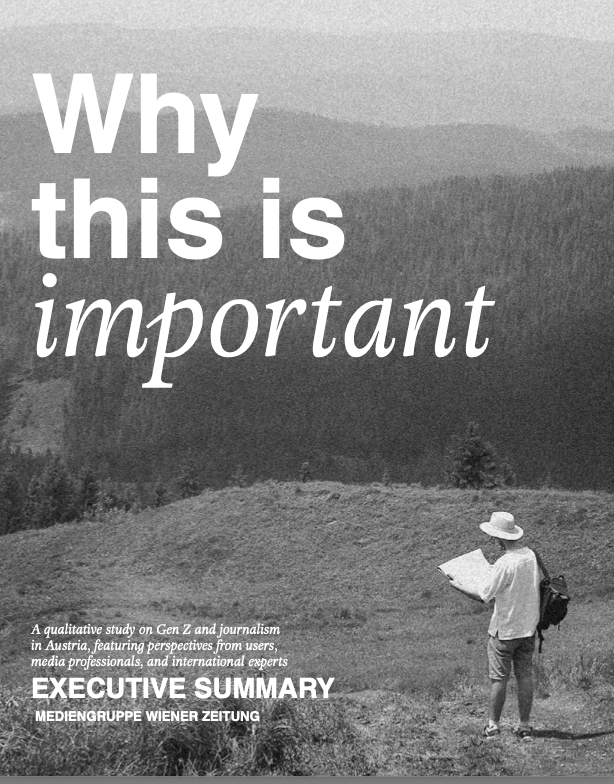
Jana Koch of Mediengruppe Wiener Zeitung and I have researched the topic for many month and led dozens of qualitative interviews. Jana spoke to young people and Austrian editors, I interviewed international experts. The result was a 150-page-report: “Knapp daneben ist auch vorbei”. You can read the executive summary in English here.  Furthermore, I will publish the expert interviews here separately one by one (stay tuned).  You can download the complete report in German (an English version is in the making).  


Interview with Alan Rusbridger: “Journalists Have Allowed Themselves to Become Part of the Culture Wars”

Although news coverage during the pandemic has seen trust in journalism rising, attacks on media have increased at the same time — not only in Germany. Alan Rusbridger knows this very well. In an interview, the journalist, who served as editor-in-chief of the British Guardian for 20 years and has just started as editor of Prospect Magazine, talks about the role of the media in a polarized world, the ongoing difficult relationship with young audiences, and the importance of climate journalism as well as public broadcasting. He does not hold back with criticism of his own industry.

Medieninsider: Alan, you just gave a speech titled “Why should they believe us?” It also deals with the low level of trust in journalism. But the numbers show that during the Corona pandemic, trust in the media has increased in many countries. At the same time, a minority is positioning itself increasingly radical against the media. What is your take on this?

Alan Rusbridger: There is a populist movement against elites that now also includes journalism. We as journalists have to ask ourselves: How could this have happened? From my point of view, there are a few reasons: One is that newsrooms have become very homogeneous. Journalism has become somewhat removed from society because it is done from the perspective of better educated people. Just as politicians have learned to play the media game, a lot of media outlets are interested in playing the political game. There is some truth in it when populists say journalists are all on the same side. Journalists have allowed themselves to become part of a culture war.

Would you explain this, please?

Let’s take climate change as an example: Journalists have made it a cultural issue. It’s about being for or against it, and not about treating it as a scientific issue. The same thing happened during the Covid pandemic. In the U.K. some media outlets have chosen to take a clear position against lockdowns.

Unlike in Germany, the majority of the media in the U.K. is conservative.

Exactly. The media don’t campaign against vaccination, but what they do is take this radical position for freedom. However, this bears no relation to public health, nor does it listen to what scientists say. Certainly, this accusation is not fair to all media; most do their best in very difficult times. Nevertheless, journalists must ask themselves about their share of responsibility for current developments.

You’ve been saying for several years that climate change is the number one issue for journalism, and that journalism has failed in this. What are you accusing your colleagues of?

For some time now, evidence has been piling up that climate change is a pressing issue and that delayed action will only cost us more. Instead of taking this seriously and acknowledging it appropriately in reporting, the opposite has happened. Many newsrooms have downsized their sciences desks, cut back on reporter teams for this topic. They have also done this because in the past it was perhaps not possible to generate many clicks or sell subscriptions with this topic. This is precisely why many media outlets have made it an issue of the culture wars.

In that sense: “tell me if you believe in climate change, and I’ll tell you your political views?”

This is a terrible mistake of journalism. It seems like journalists care more about opinion and politics than about facts. That erodes confidence in journalism in general.

What do you think about the principle of impartiality? According to the Digital News Report, the vast majority of the audience cherishes it, especially the older generation. In public service media, it is almost a religion. But many young people feel that real impartiality has never existed and that more perspectives need to be shown.

The problem already starts with the fact that impartiality is a very difficult concept. In the U.K. right now, we’re having a big debate about impartiality in a world where most newspapers are on the right. But from that perspective, the BBC, which would describe itself as strictly neutral, is already on the left. There will be no agreement between these poles about what impartiality is. The younger generation is now growing up with the perception that journalism is biased.

Coming back to climate journalism: There is evidence that this issue particularly moves and engages young people. Do you think journalism will still get its act together?

I believe that something is changing there right now. On the one hand, this has to do with a new system of values that can be found in younger generations, but also because society is beginning to rethink. Climate change has an impact on the economy, on migration, security, and many other areas of life. I think the penny has dropped in the better media houses that one reporter alone is not enough to deal with climate change in terms of content.

As a journalist, you have always been in the tradition of investigative journalism that uncovers grievances. But when it comes to the climate, you call for solution-oriented journalism. What needs to change?

Climate change is rarely featured on the front pages. That’s also because the story won’t change much in the near future. The topic only gets attention when disasters happen. That’s why journalism has a hard time dealing with this. It’s difficult even for scientists to definitively attribute such events to climate change. Journalism has to find a way to explain the issue to people accurately and clearly.

You say journalism is too negative for young people.

It’s always been hard for journalists to celebrate positive results or events. The motto is “what bleeds, leads,” and you’re not necessarily wrong with that if your business model is very focused on reach. Always highlighting the sensation, however, distorts perception. The psychologist George Marshall says that people physiologically can’t handle being too scared. That’s why it makes sense to focus on how some things can be done better. Showing people solutions and explaining how they can get involved is better than scaring them and telling them they’re all going to die.

Are people willing to pay for that kind of journalism?

If people are going to pay for any kind of news, they will be more likely to do it for this kind of journalism. It’s about addressing the issues that move people, showing them solutions, and making them feel like their actions and opinions are contributing to something. In a society where you feel your voice isn’t worth anything, nothing will change. That’s something we’re seeing in the U.K., where political power is centered in London and power is being taken away from local governments, for example.

Several media organisations are currently working on moving staff back to the regions. BBC News is doing that to a significant extent, something similar has happened in Sweden. Will that help?

It will contribute to getting closer to the people again. But it doesn’t help much to move a reporter to a place where there is no power. Changing something is not only up to the media, but also up to the government.

In Germany, power is not as centralized, yet regional newspapers in particular are suffering economically. What role will public service media play and what does their future look like?

Paying license fees or going to jail instead has been a good business model for public broadcasting. Public service media fulfills all the prerequisites for achieving what we have just been talking about. Public broadcasting doesn’t have to hunt for sensations; it can be as serious as it wants to be. Looking at the U.K., I can say: This is an important role, because otherwise you’ll encounter a lot of opinion.

Could that be the future of the media system? There’s public broadcasting that’s as neutral and serious as possible, and opinion-driven commercial media?

If you think into the blue, it’s also possible that in some regions there will be hardly any local newspapers left, or none at all, because they’ll lose their business model. If public broadcasting can absorb that, there’s no longer any reason to abolish it — except just ideology.

So, you think local journalism doesn’t have an economic future?

No, I say it should. We’re already seeing news deserts spreading in many parts of the world. What do you want to tell people in these regions later? “It was a tough business, sorry it didn’t work out”? Or do they still want to rely on media like the BBC?

… which is under heavy attack by the Johnson administration.

Just how anxious the local media are can be seen from their campaigns against the BBC. BBC Local Radio, for example, is doing a good quality job, but private media are campaigning against the public service media and claiming that they are the reason why they cannot exist. All I can say is that the evidence from the U.S. speaks a different language. There, the big public broadcaster is missing, and yet newspapers are dying. You can’t blame the New York Times alone for this. So do people really want to destroy a functioning model out of sheer spite? Just because one is ideologically opposed to public funding?

One last question not about the future of journalism, but the future of journalists. Young people often find influencers more exciting than journalists. Will enough of them even want to enter the profession?

We should first ask ourselves why influencers are so popular in the first place: They look like the people who follow them, they talk like them, and it seems like they’re moved by the same issues and concerns. You have to convince young people that there is something called professional journalism that is clearly better than anything these so-called influencers can offer. Journalists don’t deliver good work if they understand research as clicking on page two or three in the Google results. Journalism must prove that it creates value and that it is significantly better for society.

Interview: Alexandra Borchardt, published on 15th October by Medieninsider.


Desperately Seeking Youngsters – Seven Insights About a Demanding Audience

This phrase keeps popping up regularly in editorial meetings: Everyone is presenting their topics, and then one of the bosses throws it in: “We have to do something for young people.” Perplexity escapes the eyes of older participants. Maybe something about Tik Tok? About hip music or the approaching high school graduation? Everyone younger than 30 goes into hiding, just in case. They know that their most important job is to impress their over-40 superiors with clever suggestions that will go down well with the over-60 clientele. After all, they want to be taken seriously.

Established media companies and young audiences have a hard time with each other. While the former cannot do without the latter, because this would result in their economic starvation, the latter can very well do without many things that ensure the livelihood of publishers and broadcasters: Subscriptions, apps, and live TV, for example. Even with digital there is no guarantee. According to the Digital News Report 2020, 84 percent of under-25s don’t go directly to a media brand’s website, but get information from what social media, search engines or news aggregators flush into their timelines or onto their screens via push messages. This is why established media put it on the agenda again and again: Young users desperately wanted.

But what about young people’s media consumption, what do they like, what do they ignore, when do they tune in and when do they tune out? Judging by how much and how long the topic has preoccupied newsrooms, research on this is fairly slant. For the German market, two studies revealed important findings this spring.  One is “#usethenews”, published in April 2021 by the Leibniz Institute for Media Research Hans-Bredow Institute. The second one puts an emphasis on media literacy and was published in March by the Stiftung Neue Verantwortung. From this, my own research and from countless conversations with students from various disciplines, a few things have emerged that editorial strategists should know.

First: The house is indeed on fire on this topic, not only as far as the future of publishers is concerned, but also with regard to civic engagement in democracy. According to the research team at the Hans Bredow Institute, around one in two young people do not consider it important to be informed about current events. They provide the explanation right away: “Journalism often lacks a connection to young people’s everyday lives.” So it’s not enough to shrug and point to the generally rising proportion of news avoiders, which the Digital News Report puts at around one-third internationally. Among the younger generation, news abstinence is much more pronounced. Anyone who is serious about journalism as a pillar of democracy should therefore take urgent action.

Second, the gap between those who are well informed and competent and those who can barely find their way in the new information landscape is widening. Whereas formerly, even those with a low level of education used to be reasonably well informed, perhaps because there was a newspaper lying around here and there, because they watched TV news out of boredom, or were force-fed hourly radio news while driving, all of this can be completely avoided in the age of maximum distraction possibilities. The information gap that the Internet was supposed to close is opening up more and more as a digital divide between the social classes – if nothing is done. Public broadcasters with their mandate to offer journalism for everyone have a special obligation here.

Third: Fortunately, many young people are interested in the world around them after all – just not always in what seasoned politics and feature editors find exciting. Those who enjoy journalism like to check out the local news. Anything to do with environmental protection and science is thought after, at least by the better educated. Incidentally, in a recent American study on news avoidance (“The head and heart of news avoidance”), it were also stories touching health, science, the environment and local affairs that news avoiders of all generations were most likely to be interested in. Newsrooms whose informal pecking order starts with the politics desk followed by a large gap will have to adjust.

Fourth, what unites all users of the younger generations is a preference for light subject matter. According to the Leibniz study, “funny and strange” is consistently well received. In any case, humor is a pretty sure way to get a hearing among generations Y and Z, as evidenced not only by Böhmermann and Co. But beware, it’s not necessarily the kind of humor that those same mature executives like. Joking at the expense of weaker people is not acceptable. Those who dish it out have to at least take a joke themselves once in a while. In the humor department of journalism, the same applies as with uncertain sources: If in doubt, leave it alone.

Fifth: There’s no way around influencers, but they don’t have to be Instagram marketing heroes. When the Swedish daily newspaper Dagens Nyheter had Greta Thunberg head the newsdesk for one day last year, digital subscriptions came rushing in, several thousand in one day. Celebrities increase reach and help get messages across. Rule of thumb: Celebrities should come across as people, not officials. Having the movie star talk about politics and the politician talk about movies can make both more credible, if they mean it honestly. Young people are trained to distinguish between genuine authenticity and staged approachability.

Sixth, diversity counts – and not just as a box-ticking exercise. Young people expect a program or brand to portray the world as they experience it. They may be able to identify with protagonists and perhaps even contribute something themselves. This includes language that is both casual and respectful and content that – see above – has something to do with their everyday lives. News should be useful and fun, was the conclusion of a study on young journalism users published by market researcher Flamingo together with the Reuters Institute in 2019. Constructive journalism that opens the world wide with perspectives is therefore particularly well received by the young generation. Rule of thumb: You can trust the audience with something. The success of science-driven formats such as Brainstorm by Irish public broadcaster RTE or the German magazine Katapult are proof of this. It’s a pity for cost killers that in-depth research is usually more time-consuming than dishing out news copy-and-paste style. But quick news is everywhere these days. You could say that young people are journalism gourmets.

Seventh: Journalism must be easily accessible and well prepared. Digitization trains all generations for convenience; Amazon, PayPal, Spotify and Co. have set the gold standard for user-friendliness. The old world, in which people still read instruction manuals, wrote down phone numbers and went to the kiosk on the corner, is disappearing. For journalism, this means it has to go where the users are and make it easy for them. The American study mentioned above says that barriers to understanding and a lack of self-confidence in dealing with the media are the main reasons why people give news a wide berth. When in doubt, the interactive infographic with three bullet points beats the 200-line editorial. This is bitter for some authors. While complexity used to be a sign of quality, today it has to be well justified. This is good. Because in the past it has all too often merely concealed incompetence or laziness.

This column was published in German on May 17, 2021 by Medieninsider. It was translated by DeepL and then edited.

In the fun business – Journalism that wants to reach young audiences needs to work on humour

Journalism is serious business. Just recently, a Greek investigative reporter was shot dead outside his home in a suburb of Athens. Even in Germany journalists are increasingly being physically attacked, which is why Reporters Beyond Borders downgraded the country’s state of press freedom from “good” to “satisfactory” in its latest report. Especially in Central and Eastern Europe, politicians and oligarchs are cornering independent media. And then German comedian Jan Böhmermann came along and landed a newsstand, TV and social media hit with a satirical magazine, “Freizeit Magazin Royale”, poking fun of German publishers. What got young people most worked up? Guess: that Böhmermann’s magazine was out of print after a few days.

One should still not deny young audiences a sense of seriousness too easily. Humor is a serious matter, and it doesn’t take attacks on caricaturists to get this. The trend of young people increasingly approaching the news through comedy has been showing for a while. A study in the journal Journalism highlighted this in the U.S. as early as 2007, a decade after the launch of “The Daily Show” on Comedy Central. Since then, corresponding formats have been developed in many places. Modern newsrooms better get down to this soon: Mastering lighter formats is the key to getting the next generation excited about news. This is easier written than done though.

Satire is one of the journalistic genres that fails most often. What is satire, what is just bad taste and what is even inhumane? This was the subject of a heated debate in Germany just under a year ago, when a not-so-funny column by Hengameh Yaghoobifarah in the taz newspaper equated the police with garbage and therefore caused a lot of concern – right up to the Federal Minister of the Interior and the German Press Council. Even more than other forms of journalism, which can be mastered acceptably with craft, persistence and a lot of practice, satire requires a certain talent – in other words, humor. To make matters worse, this is even culturally coded.

Not everyone can and should laugh at everything. Humor exerts power, and therefore tends to work better from bottom up. There is a huge difference between rebelling against established power structures and cementing them by joking from above. For this reason, a show in which privileged presenters amuse themselves about political correctness is very prone to go wrong. This happened famously with the failed #allesdichtmachen campaign, in which well-known actors supposedly wanted to argue ironically for freedom of expression in the Covid 19 crisis. Too bad that parts of the public perceived this, at best, as whining from the designer kitchen.  

American communications scholar Danna Young describes in her 2019 book “Irony and Outrage” that satire involves a certain basic liberal attitude that values freedom of thought and takes a playful approach to serious things in life. The counterpart to this in the right-wing political spectrum is the rise of rage talk shows, she argues.

The traditional media move between these poles. Their journalists work in the facts business and rarely in the humor field. Facts are unambiguous and clear by definition. Humor is ambiguous and lives through interpretation. Mixing things up is dangerous. Especially in social media, humor is often difficult to identify. Moreover, many reporters and commentators rarely feel like laughing (see above), cynicism excluded.

Still, humor works just fine with young audiences. Rule number one: It must not underestimate its addressees. The German (print) magazine Katapult is such a hit with the young generation, because it casually mixes factual depth and lightness. Subtitle: “Magazine for icecream, cartography and social science”, need we explain more? Young users prefer journalism that explains, is useful in their daily lives, and is fun, according to a study published by the Reuters Institute in Oxford.

The fun factor is still limited when consuming most established media. In the past, it was considered proof of belonging to the educated class, if one had to struggle properly while reading the newspaper. Today, status postures only trigger boredom. After all, the more easily digestible alternative is already waiting – on YouTube or Tik Tok. Now, it’s not about replacing news and analysis with satire. If you can’t bring it up to premium quality when it comes to humor, you better leave it. What everyone can work on, however, is tone. Many podcasts work so well because they come across as light and chatty.

Newspapers can still work on it. Some essays exude more enthusiasm of the writers about themselves and their clever sentences rather than mastery of language. To the audience, they only seem embarrassing. Young people in particular have good antennae for jokes being made at the expense of the weak. They don’t perceive it as funny, but as offensive and discriminatory. Lecturing is out, taking seriously is in. When in doubt, it’s okay to make fun of yourself. You don’t even have to be a comedian to do that.

This column appeared in German in the newsletter of the Digital Journalism Fellowship at Hamburg Media School on April 23, 2021. Translated with www.DeepL.com/Translator (free version) and then edited.