

Looking at the Brexit mess from outside of the UK, it doesn’t take much for observers to conclude at least one thing: the British don’t understand the EU. Leavers display a downright hostility through their portrayal of the EU as some bureaucratic, money gobbling behemoth, determined to cripple Britain’s autonomy, but this completely misses the point. It should be common knowledge, at least in elite circles, that the bloc was conceived after two atrocious wars primarily to prevent people from shooting at each other again. Then again, it is safe to say that the lack of insights is mutual: most European citizens have been baffled by the UK and Brexit. But what is even worse is that many inhabitants of the ‘London bubble’ around Westminster and Whitehall don’t seem to understand the rest of the UK either.
Having moved to the Southeast of England from Germany a little more than a year ago, following the Brexit debates has been fascinating. They reveal a country, and especially an elite, that on the one hand is proud of its heritage as a former world superpower, but on the other is often ignorant of so much that happens outside central London, and even less on the other side of the English Channel. In a media environment firmly rooted in the UK’s capital, it is as easy, if not sometimes easier, to stay informed about what happens in India, China or Australia, than about what the challenges are in Leeds, Liverpool, Glasgow, or Cardiff.
By contrast, Germany benefits from a very different system with its federalism and strong regions, many of them with a strong industrial core and sizeable media organisations. The German capital, Berlin, does not dominate German politics like London does. But Germany is also different because it was forced to confront its devastating past. For West Germany to survive morally and economically, it was essential to forge alliances with former enemies to move towards a peaceful European future; a future our children will hopefully enjoy for decades to come.
Yes, the EU was created on shared economic interest, but its vision has always been political. The founding members of the European Coal and Steel Community in 1951 promoted the idea that economic cooperation would foster political comprehension, six years later the Treaty of Rome affirmed that belief. Trade and economic relations have always been underpinned by strong images of political cooperation. The iconic photo of then German Chancellor Helmut Kohl and French President Francois Mitterrand holding hands at a war cemetery in Verdun in 1984 comes to mind. It was just recently mirrored by the embrace of German Chancellor Angela Merkel and French President Emmanuel Macron at a ceremony marking the centenary of the end of the First World War. In the 1990s, the Eurozone was not primarily invented to spur growth but to take one more step towards political unity after the fall of the iron curtain.
Sadly, too many in the UK’s elite in London don’t look at the EU that way. At least that is what it feels like. Some of London’s elites until recently cultivated the image of a predatory Nazi-Germany. It’s clearer than ever that Britain engaged in European integration mostly to reap some economic benefits, not for political reasons. This means that the narrative of peace and cooperation was completely lost on many in the UK. And when the economic benefits fell through, for them there was not even a shadow left of the real story of the European Union.
Maybe it would have been easier if the story of the UK itself was one of a proud union. But the Brexit debate has revealed that the UK’s own differences were given insufficient thought. The absence of reflection about the Irish question is a sad testimony of this. Had anybody responsible thought about the fragile situation at the Northern Ireland border, the Brexit referendum might not have been conceived so easily. And obviously, there was not much reflection about economic consequences either such as inflation, or of transport connections, fishing rights and many more. The “us British” versus “them Europeans” narrative of British autonomy was sold to economically challenged citizens across the UK without alerting them to the fact that the EU has worked to their advantage. Citizens outside London, desperate for the attention of their policymakers, fell victim to a power play by some privileged Londoners.
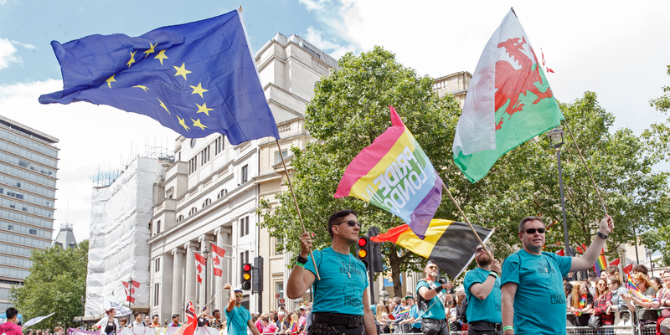 Image (cropped) by katy-at-katyblackwood.co.uk, (CC BY-SA 4.0).
So what’s the view from outside the UK’s – and London – bubble? Frankly, many Europeans couldn’t care less about Brexit. That’s what the Reuters Institute for the Study of Journalism and the media research specialist Prime Research concluded in their study “Interested but not engaged: How Europe’s Media Cover Brexit”. They found that major European media outlets in eight countries dutifully covered the Brexit process, but regarded it as Britain’s own problem rather than a European challenge. French media were the most outspoken on this, confidently suggesting that the EU might be better off without a nagging neighbour constantly putting its foot on the brake. The Europeans concerned the most have been the Irish, who know that the mess will be theirs to shoulder, once London’s Brexiteers have retreated into their bubble.
Of course, international Brexit reporting has been shaped by the London perspective on things as well. All foreign media have their correspondents stationed in London, with only the more privileged of them entitled to the luxury of extensive travel through other parts of the UK. Consequently, the foreign press spends most of their time with the “he said, she said” type of reporting centring around the negotiations in Westminster, Whitehall and Brussels, as the Reuters Institute study revealed. Very little reporting has revolved around issues like citizen’s rights, around the consequences Brexit might have for ordinary people, with some concern shown only about trade and business relations. European media portray Brexit mostly as a battle between Westminster and Brussels, rather than as a grave policy step affecting real people outside central London and across the UK.
Of course, correspondents usually mirror the local press, and if that press is based in London, then the London view will be what is transported beyond the border. The decline of regional news organisations hasn’t helped. The BBC World Service broadcasts in more than 40 languages, yet between London and the rest of the UK, much seems to be lost in translation.
This text was published by the London School of Economics and Political Sciences Brexit Blog on 7th January 2019
OXFORD – The brutal torture and murder of the US-based Saudi journalist Jamal Khashoggi has focused attention on Saudi Crown Prince Mohammed bin Salman, who is widely believed to have ordered the killing. It also highlights the hazards of the news business. When the final numbers are tallied, 2018 could be the most dangerous year on record for journalists worldwide.
But while physical attacks on journalists have become frighteningly bold – and Khashoggi’s killing may be the most audacious yet – most dangers confronting the profession are much more mundane. Five stand out.
First, the number of job opportunities is dwindling, and positions are characterized by low pay, perpetual job insecurity, and limited opportunities for advancement. In the United States, for example, newsroom employment has dropped nearly one-quarter in less than ten years, while enrollment in top journalism schools has tapered off more recently.
Second, “Big Tech” is outcompeting news organizations in the race to attract limited talent. Journalism needs people skilled in technology to lead investigative reporting projects and to manage the industry’s digital transition. But at the moment, most computer engineers see a brighter future with platform companies like Facebook and Google, which can offer higher pay, more job security, and better work-life balance than even the biggest media outlets.
Third, journalism is a lot less glamorous than it once was. Years ago, weather-beaten foreign correspondents on television or the front pages of major newspapers lured young reporters to the craft. And, although most of us who took the bait never ventured farther than city hall, we were nonetheless driven by the noble mission of holding the powerful to account. But in today’s distributed social-media environment, foreign correspondents are rare, and media “influencers” are more likely to be pop stars than policy wonks.
Fourth, even as pay and prestige diminish, newsroom pressures are intensifying. When a “cub” reporter joins a media organization today, the ability to write great copy is no longer sufficient; young journalists must also possess audio and video skills, data journalism capabilities, and social-media savvy. These skills might lead to better news products, but nobody is good at everything. To demand that they are and place endless demands on them might encourage reporters to leave the profession.
Finally, the relentless rhetorical attacks on members of the mainstream media by leaders like US President Donald Trump – whose “fake news” narrative targets the credibility of the profession itself – is having an effect. Although confidence in the news media has been rising in recent surveys, the constant vilification of journalists’ integrity and intelligence threatens to erode the profession.
Together, these five challenges are taking a heavy toll on the news business, and this poses a risk to democracy itself. Without free and independent media, citizens cannot make informed decisions. In fact, when professional journalism is absent, people can easily become lost in a maze of often-unreliable information, or even fall prey to self-proclaimed, interest-driven experts and propaganda. Journalism is democracy’s compass; we must find a way to recalibrate it.
First and foremost, journalists need protection. That means ensuring not only their safety, but also their ability to access information and report their findings without fear of reprisal. At a minimum, attacks on journalists like Khashoggi must be fully investigated, and their perpetrators must be held to account and condemned by the international community.
And yet, support for the media must go beyond punishing those with the audacity to kill a reporter. For example, more programs are needed to help nurture young talent. Governments could offer subsidies, give tax breaks, and sponsor initiatives that offer training in journalism and new media. Future journalists need role models, but they also need the technical skills to become role models themselves.
Perhaps most important, media advocates everywhere must work to increase the public’s media literacy. News consumers must understand how journalism works, how journalists do their jobs, and why professional media outlets are essential components of a well-functioning democracy. Until the public values the output that professional journalists produce, a shortage of talent will be the next big challenge for journalism. It could turn out to be its biggest yet.
This column was published by Project Syndicate on November 27, 2018